Uranium glass (Vaseline glass) for Trains
and Cars
| 1) Golden Glow Light (Uranium glass headlight)
on Japanese steam locomotives |
In March 2003, Japanese Magazine "Railway Fans,"
issued a very interesting article as "80 yeas ago, the steam locomotives
and some trains used the so called "Golden Glow Light ", and it used a uranium glass (vaseline
glass) headlight ", written by Jun-nosuke
Oomori, who is a member of JUGCC).
In January 2006, JUGCC (Japan Uranium Glass Collectors Club) visited the Transport Museum in Tokyo, because they
have the above headlight (Golden Glow Light). This Museum closed in 2006, and now they re-opened in Saitama
Prefecture in 2007.
The museum's chief picked up the locomotive
headlight of the two Golden Glow Lights from the warehouse.
( photos by Mr Takashima of JUGCC)
Following two vaseline glass headlights are
the Transport Museum's collection, and the
copyright belongs to them. So, please do
not copy the following photos of Golden Glow
Lights.
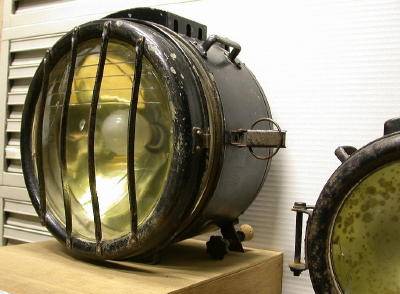
This is the steam locomotive headlight as
"Golden Glow Light", yellow reflector(mirrors) part is made
of vaseline glass.
The front cages are to protect against snow
and/or tree branches.
 |
The front cover is opened.
The vaseline glass is used as the yellow
surface of the reflecting mirror.
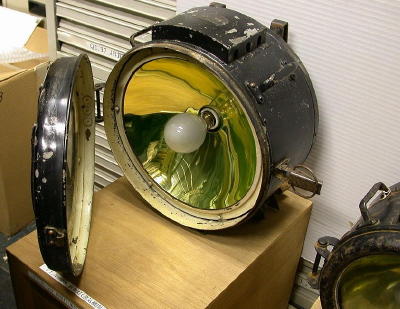 |
Photo under Ultra-Violet light.
Reflector (vaseline glass) shows green
fluorescence.
= Diameter is about 30 cm. 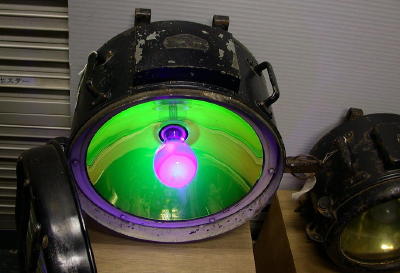
|
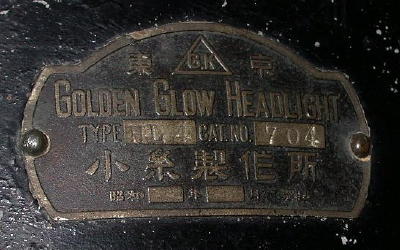
At the top of golden glow headlight, there
is a "Koito Manufacturing Co"and
GOLDEN GLOW FLOODLIGHT on the nameplate,
but age is unreadable.
|
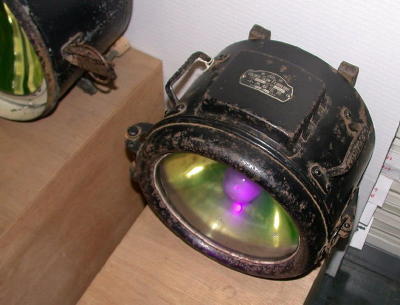
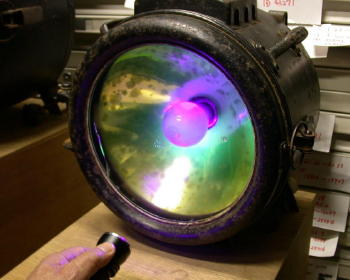
This is the second one, which is a little
small, and was used as the electric-train's
headlight.
Diameter is about 20 cm.
 |
Under Ultra-Violet light with green fluorescence.
 |
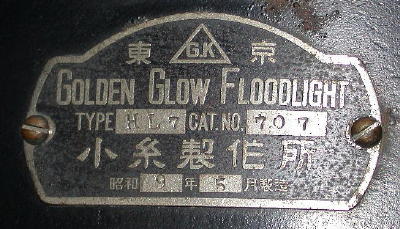
Right photo:
At the top of this headlight, Koito Manufacturing
Co., Showa 9 May" (year-1934)
and Golden
Glow Floodlight are shown in the nameplate. |
 |
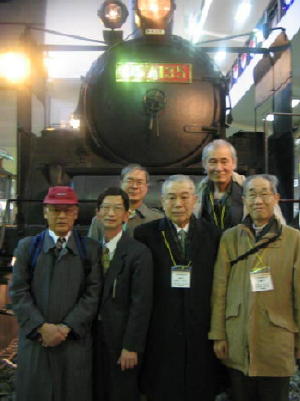
Right photo:
JUGCC members, who visited the Transport Museum.
The back is the steam locomotive.(The
lamp
is NOT a vaseline glass.)
|
 |
We walked down to the station underground
as a tour.
(This is a last chance to see here,
because
this museum was closed soon after)
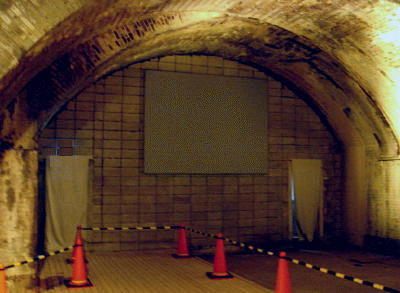 |
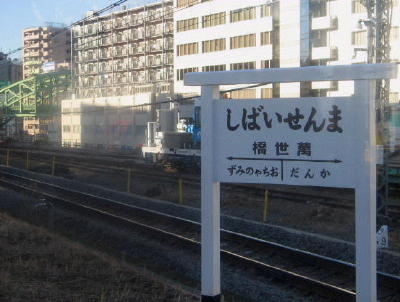
This is top of the museum, Mansei-bashi station
platform, which was closed longtime
ago.The Central Line train will take you
to this
old station between Kanda and Ochanomizu,
but not used anymore.
 |
The Odor's article on "Golden Glow Light" says that it was attached to the Emperor's
train, and that steam locomotive is still
exhibited at the Kyoto Umekouzi Train Museum.
I have visited there in November 2004.
Almost 10 steam locomotives are shown, and
I tested ultraviolet light irradiation to
all of them.
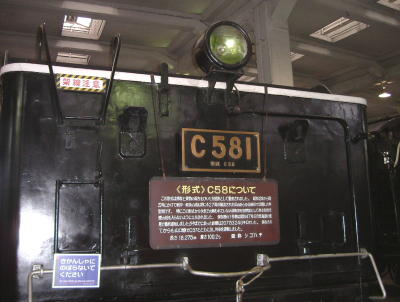
After all, only one locomotive "C58"'s rear light was Uranium
Glass..
The above article said that "C51 front
headlight is vaseline glass". Its color
is pale yellow but not a vaseline glass.
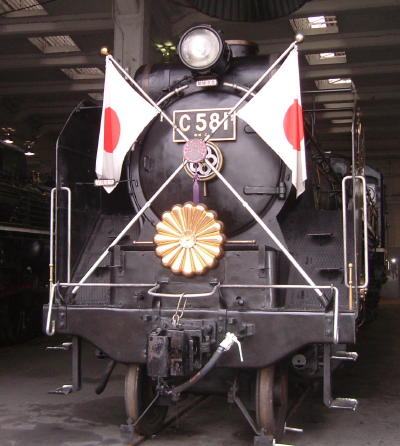
The steam locomotive is the Emperor's train
"C58"
Chrysanthemum flower means that this
train
belonged to the Emperor.
|
"C58"'s rear lamp is "Golden
Glow Light" (uranium glass)
|
The lamp maker Koito Manufacturing Co. (still operating) used vaseline glass as
a headlight, because it has the shorter wavelength
of light, and strong penetration force.
Also, the company's data is provided as,
the silicon oxide = 57%, soda ash = 18%,
10 molecular boric sand= 13%, calcium carbonate
= 5%, potassium nitrate = 7%, arsenite =
0.7%, heavy uranium sodium = 0.4%.
The manufacturing of vaseline glass Golden Glow Light has started at Showa-2 (year-1927), and
was stopped in Showa-16 (1941) due to the
War. It was only 14-years production, and
total number is not recorded, but it may
be several thousands.
After then, potassium dichromate-yellow colored
(not a vaseline glass) "Golden Glow Light" was used .
2) "Battlefield Bridge":
Thailand steam locomotive also uses
headlights
of uranium glass |
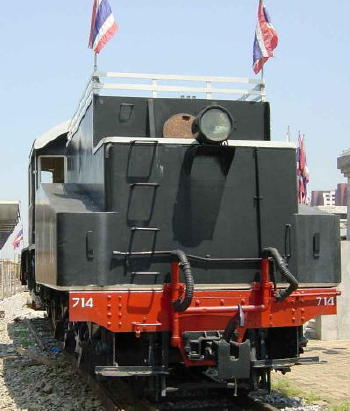
After the above article, Mr. Nakamura (our
club member residing in Singapore) visited
Bangkok of Thailand, and found this Golden
glow light.
About 200 steam locomotives of C56 type were
produced in Japan in the War time. Among
200, 90 steam locomotives were exported to
south Asia.
According to his inquiry to the Ministry
of Railway of Thailand, this train was actually
from Japan, and the Thailand government decided
to exhibit it at the station. There is no
record of repairing the light, and the light
may be a golden glow light, they say.
This train was used in the railway, which
was shown in the famous UK movie "The Bridge on The River Kwai".
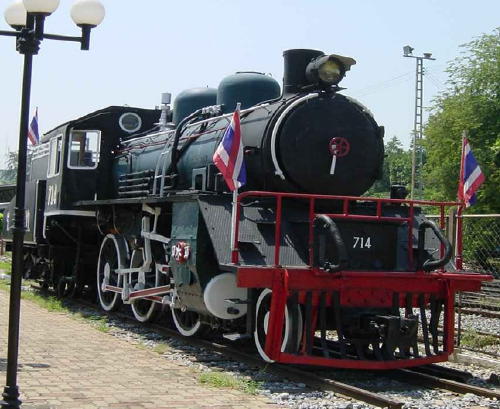
Mr, Nakamura took a photo of Bangkok station's
Japanese steam locomotive C56.Certainly, the headlight is pale green, and
it is the vaseline glass. (March 2003)
Bangkok station "C56" (Headlight
is vaseline glass)
|
Backward photos (back light looks also vaseline
glass)
|
| 3) The Yasukuni Shrine's SL: C56 (back from
Thailand-Burma) |
In Showa-11(year-1936), Japan sent 90 steam
locomotives to Thailand or Burma. They were
used as shown above. After War, all were
abandoned.
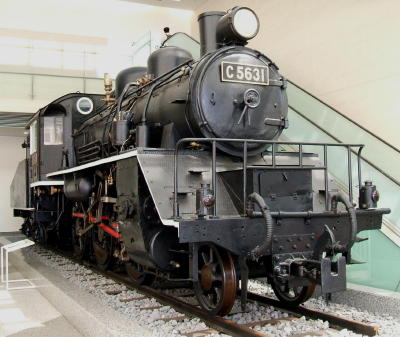
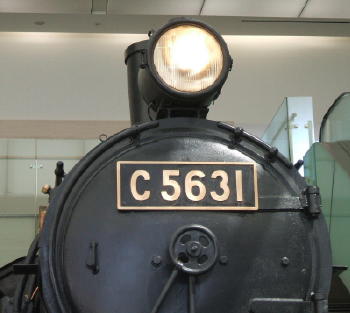
In 1952, two C56 trains came back to Japan,
and one is shown at the Yasukuni Shrine (Tokyo).Unfortunately,
headlight was repaired and it is not a Vaseline
glass. (In autumn 2006)
|
Yasukuni Shrine's SL, and it is not a vaseline
glass.
 |
| 4) British car headlights are also uranium glass |
Headlight of uranium glass was used not only
in the locomotives
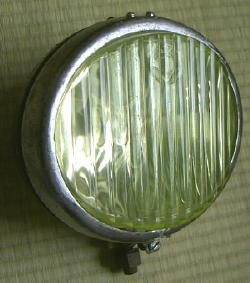
A certain Nagoya antiques dealer (Mr. S)
imported this automobile head lamp
made of
vaseline glass.
In U.K. in 1910-20, "NOTEK, FOG - MASTER"(engraved on the glass) was used as
a fog lamp for cars.
The diameter is 23 cm. The front of the glass
thickness of 2 cm, and it is yellow
vaseline
glass.
The vaseline glass causes the shorter wavelength
of light, and it has strong transmission
power. Since UK is a foggy country,
it was
the right thing.
In Japan's locomotive headlight, the
reflector
is the vaseline glass.
The British car headlights use vaseline
glass
as a front glass of the light. So,
the principle
is different.
(June 2003)
"NOTEK" was one of the largest lamp manufacturer
in Germany/Munich before the World
War, and
it stands for "NOva-TEchniK GmbH"/
It is said that they installed this
lamp
as a fog lamp to the German trains,
besides
automotive.(Nov. 2007) |
 |
| 5) Who is the first person to name GOLDEN GLOW? |
|
Glass Reflectors
Glass mirror reflectors are also used
for
automobile headlights. These are generally
of the so-called "Golden Glow" type, which are made of a special
glass having a greenish golden color.
The
light reflected by this lens is of
a golden
hue and is claimed to penetrate a foggy
atmosphere
to a much greater distance than a white
or
violet light. The back of the reflector
is
"silvered" in the same way
as a
mirror. The source of light, of course,
sends
out rays of all colors; but since the
reflection
takes place at the "silvered"
surface
at the back of the reflector, the reflected
light must pass through the glass,
and in
doing so the violet and blue rays are
absorbed,
while the yellow rays are reflected.Source:
The Gasoline Automobile by Peter Martin Heldt, 1918
The source also mentions that a company
called
Esterline (later Esterline Angus Instrument)
made an automobile headlamp using a
Golden Glow reflector. It would seem that “Golden
Glow” was used loosely to describe
such
reflectors. (by Tim, USA, 2008)
|
I would mention one difference that train's
head-light uses vaseline glass in its mirror,
and automobile's fog-light uses vaseline
glass in its front glass.
| 6) USA Steam Locomotive head light (Golden glow light in US trains) |
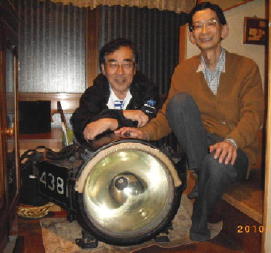
Recently, we acquired a big train head light
of US steam locomotive made by the Pyle-National Company for the Lackawanna Railways.(later this train was sold to the Alton&Southern Railways.)
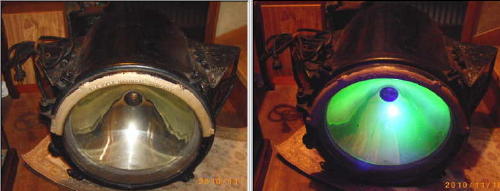
It is similar to the above Japanese train
light, and using uranium glass in its mirror.
The radio-activity is about 5 times higher
than back-ground and weak.
Its company name(Pyle-National Company) is embossed on the top of the light, and
this company developed the incandescent lamp
for trains in 1913. It is not sure that 1913
lamp applied uranium glass reflector or not,
but the age is at least 1913 to 1920.
It is 77cm wide, and light diameter is 44cm,
very heavy!.
(2010/Dec)
Head lamp of US Steam Locomotive.
|
US train Head light (Left:natural light,
Right: under UV light)
Its mirror is using uranium glass.
 |
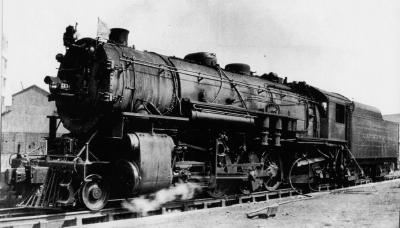
| MIKADO-type locomotive No.2134 at the Lackawanna Railways in USA |
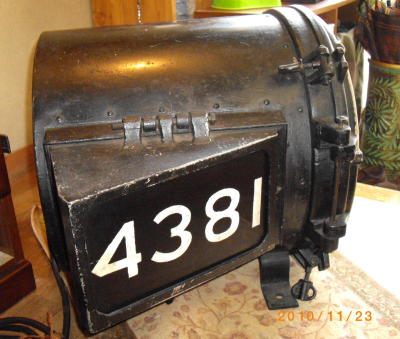
The left locomotive moved to Alton&Southern Railway as No.4381, and this lamp.shows its number. |
This photo panel and the lamp are donated
to the Fairywood Museum in Japan. |
 |
| 7) Another USA Steam Locomotive head light |
In 2014,, Mr. Rick, who is a railway collector
in USA, sent me an email, that he wanted
to confirm whether his head lights were using
vaseline glass or not. After several talks,
he send me the following conclusion.
"There are 3-types of vaseline-glassed
SL head lights, and he owns No1 and No.2
as follows..
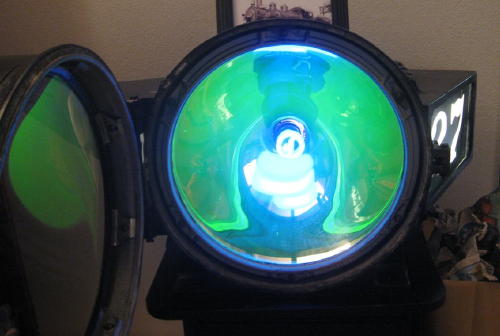
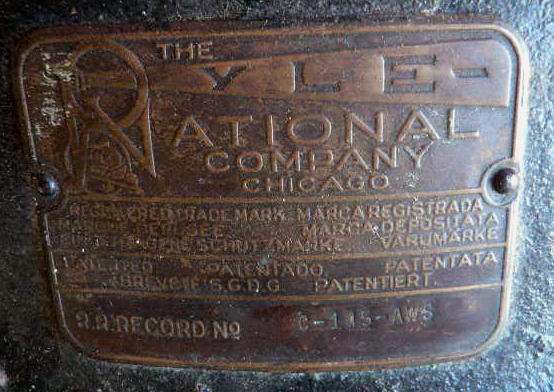
| 1)Pyle-National Company。 |
This is identical to the above head light.
Maybe around year-1920. |
 |
 |
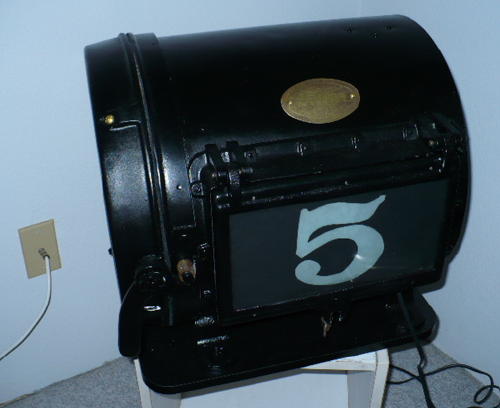
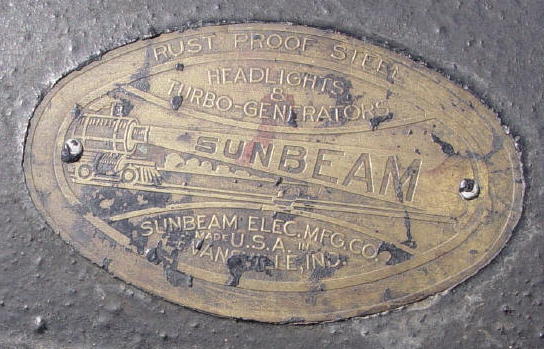
2)Sunbeam Electric Manufacturing Company
|
No,1 and No.2 do not claim as "Golden
Glow Light", but both are using vaseline
glass as mirror. |
 |
 |
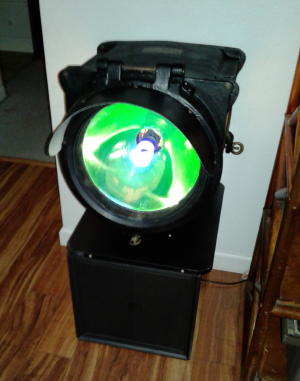
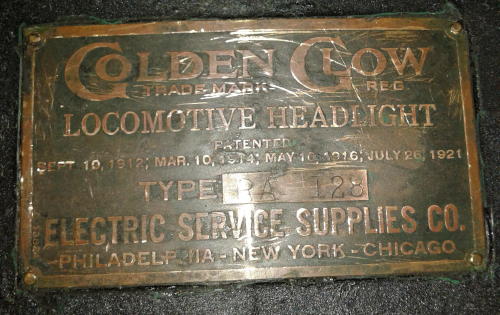
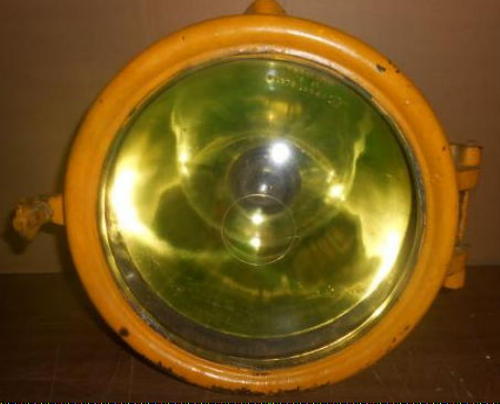
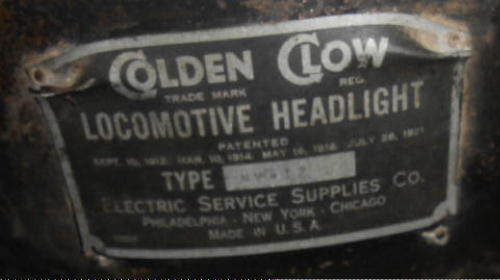
| 3A)Electric Service Supplies Co. of Philadelphia (ESSCo) |
"Golden Glow Light" may be a registered
trade mark of this ESSCo.
Japanese Koito Manufacturing Co. might have
some relation with ESSCo. |
 |
 |
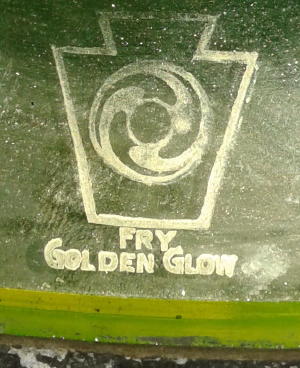
3B)Electric Service Supplies Co. of Philadelphia (ESSCo)
In 2017, Rick send me another ESSCo headlight,
which says "Golden Glow, registered
in 1912".
Reflector glass is made by Fry Glass Co.
In 2017, Mr. Paul informed us that
(1)"Golden Glow" was registered by Fry Glass Company in 1912, which has been established by Henry
Clay Fry in 1902.
(2) Fry Glass provided this trademark (and
maybe glass itself) to three US companies,
which are Apple Electric Company, Esterline Electric Company, and Electric Service Supplies Company.
(3) Fry Glass became receivership in 1926,
and was closed in 1933.
(4) Koito Manufacturing case is unclear,
but it was possible that Fry Glass wanted
to sell everything.
http://glassian.org/Fry/
Vaseline glass (Uranium glass) have been
mostly used at homes.The only scientific/industrial
use is this head-light, and Vacuum Tubes (click here).
Back to Uranium glass club Page